
BOSCO Team Spotlight
Rebecca Kisaakye, From Classroom to Field
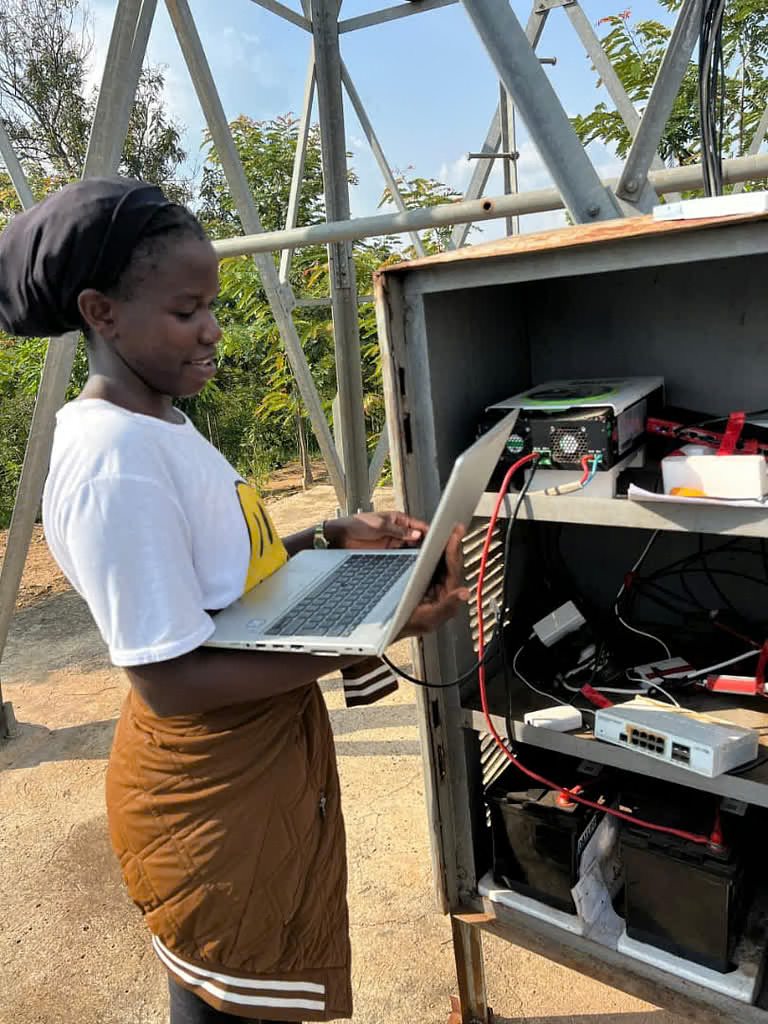
Team Spotlight introduces the people who keep BOSCO Uganda’s network running in northern Uganda. Technical intern Kisaakye Rebecca moved from classroom simulations to the field to gain hands-on experience in network troubleshooting, computer maintenance, and clean energy systems across Omoro District and Opit.
By Kisaakye Rebecca | Technical Intern, BOSCO Uganda
Before joining our field operations, much of my technical training was rooted in theory and software simulations. I was eager to gain hands-on experience, learn practical network troubleshooting, and see how clean energy and technology directly impact rural communities.
Power and Maintenance in Omoro District.
During field operations in Omoro District, our team encountered a critical disruption at a school site where a single faulty connection had cut off power to vital equipment, including the lights, a MikroTik AP, and a PowerBeam M5 400. Once the connection was safely secured, power was fully restored to the site.
To avoid a sudden outage, we rerouted the networking gear directly to a backup power source. This kept the connection online while giving the main solar rig room to safely recharge the batteries—a quick operational call that saved the site from going dark.
Restoring Tower Connectivity on Opit Hill.
Fixing the solar system was only part of the work, though. I also took on several computer maintenance tasks to support the institution:
- Updated outdated software: Refreshed outdated Windows operating systems on the school’s laptops.
- Activated licenses: Successfully activated Microsoft Office licenses across three HP laptops.
- Enhanced system security: Installed MS Office and updated antivirus software on an additional desktop.
Later on, during diagnostics involving the local Access Point and the PowerBeam M5 400 at Atyang, which wasn’t linking properly with the station at Moro Hill in Opit, we rebooted the device to restore local communication. Because internet flow remained blocked, further inspection revealed that the LAN cable from the station required additional work.
On our field mission to Moro Hill in Opit, the team discovered a hidden obstacle: a previous crew had left the solar panel cables unplugged from the batteries. After carefully reconnecting the cables and re-establishing a steady power flow, we ran comprehensive ping tests across the network devices to verify full, seamless connectivity.
Takeaway from the Field: Moving from theoretical study to active fieldwork highlights how crucial rapid diagnostics, hardware maintenance, and proper power management are to sustaining rural connectivity.
Key Practical Skills Gained.
- Diagnosing and resolving network connection blockages, wireless link issues, and faulty LAN cabling.
- Performing essential computer maintenance, operating system updates, license activations, and antivirus installations.
- Managing off-grid solar power setups, troubleshooting battery and panel connections, and verifying system power flow.
- Executing end-to-end network ping tests to confirm robust device communication across remote sites.
My time at BOSCO Uganda successfully bridged the gap between classroom theory and real-world field engineering, giving me a much deeper appreciation for building resilient communication systems for rural communities.
Keep the network running.
Routine inspections, power restoration, hardware upkeep, and engineers who head out into the field when a link goes down: that work keeps BOSCO Uganda’s network online for rural communities across northern Uganda. A gift to BOSCO International supports BOSCO Uganda’s field team and the equipment they maintain.